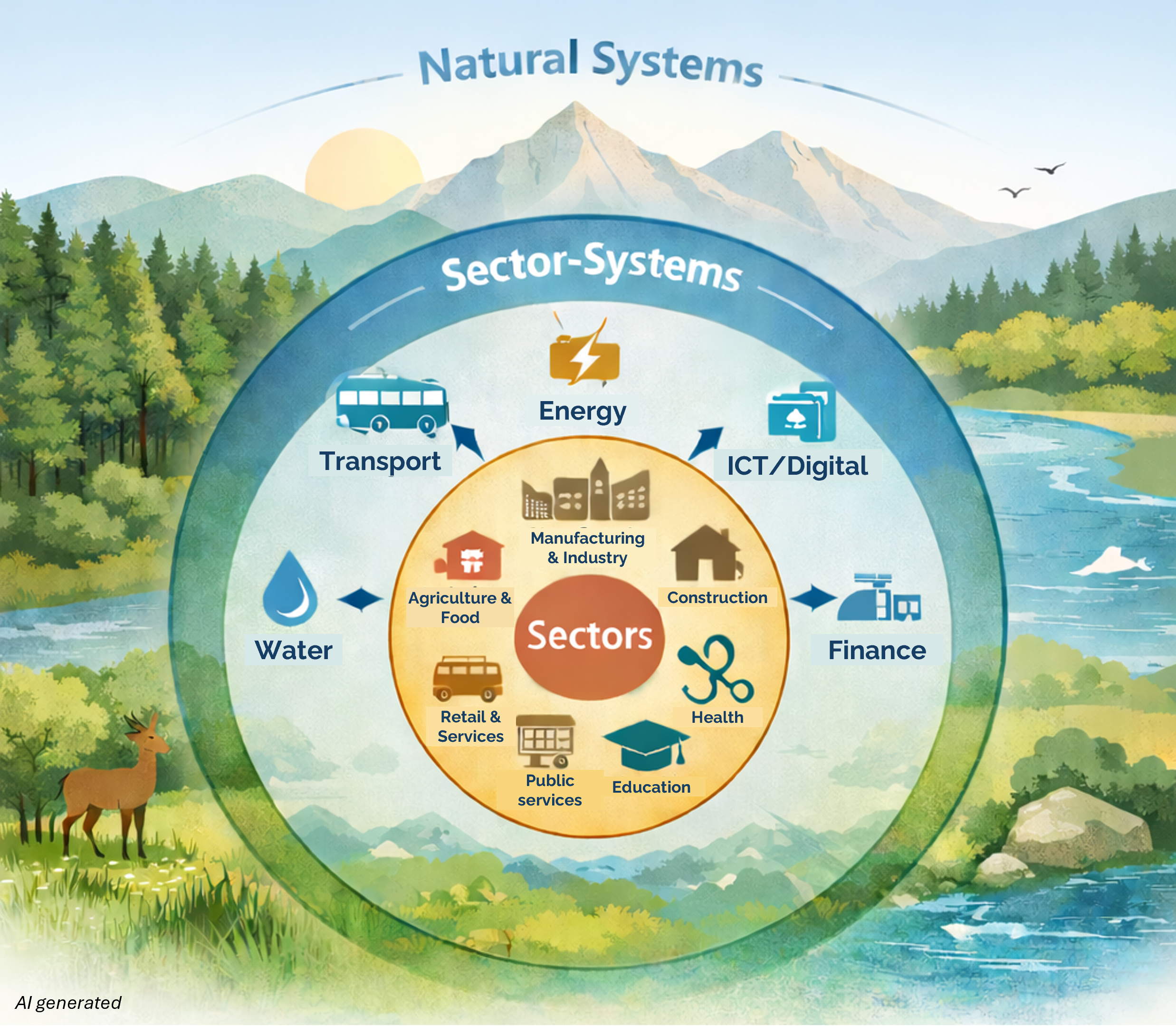
Several people have asked me for my takeaways from COP30, especially related to resilient supply chains and logistics. Here is my top 10, in line with the Life-Links Framework: looking at the logistics system as a whole, the critical transport links within it, and the communities, companies and countries who depend on those links to “stay alive”. I tried to be constructive, because there are real opportunities emerging despite the gaps.
1. Adaptation gained political weight: now address supply chains clearly
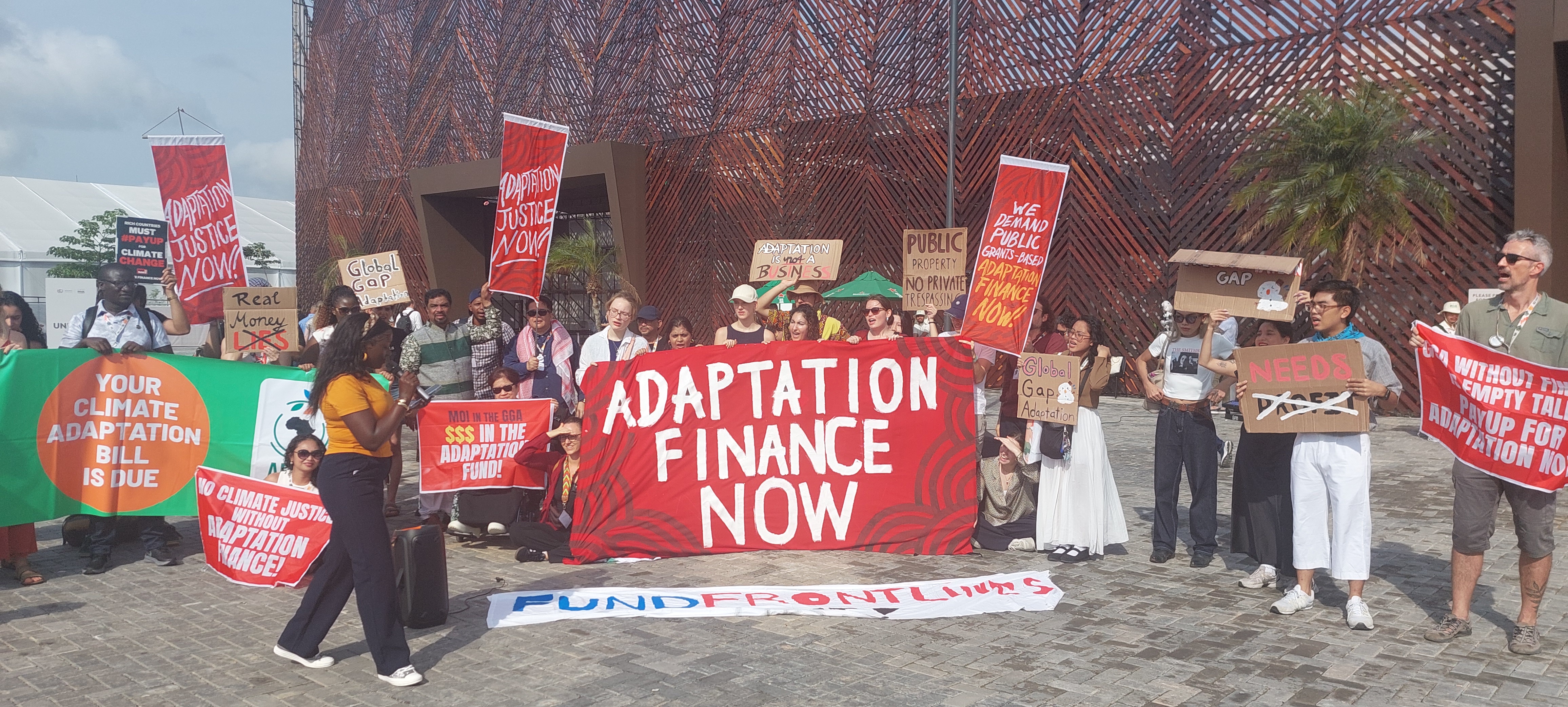
The call in the COP30 “Global Mutirão” decision to at least triple adaptation finance by 2035 is important. It shows that adaptation is no longer treated as secondary. It also mentions international trade to say that climate measures should not be used to restrict it. What is missing is equally important: it does not talk about cooperation on international trade, it does not acknowledge the importance of global supply chains that all of us depend on, and it does not address the adaptation needs of logistics systems and the transport links essential for moving goods.
Opportunity: There is now a political opening for governments, companies and funders to make the case that supply chains and logistics systems need to be included in future adaptation finance frameworks.
2. New adaptation indicators were adopted: propose supply chain and logistics metrics
COP30 agreed on 59 indicators for the Global Goal on Adaptation (GGA). These indicators are intended to help countries track adaptation progress across sectors such as water, food systems, ecosystems, health, livelihoods, infrastructure and human settlements. But they don’t touch on supply chains or logistics/transport systems that interact with these sectors. Climate hazards often disrupt these weakest transport links first, so leaving them out is surprising.
Opportunity: The two-year (i.e. until COP32) “Belém-Addis work programme” to refine these indicators gives space to propose supply chain and logistics relevant metrics, and to go beyond infrastructure to also cover operations and the workforce. The Life-Links Framework provides example indicators for risk and resilience for logistics. Then we can measure resilience at the places where resilience might break!
3. COP30 Action Agenda: connect the transport pieces across “Plans to Accelerate Solutions”
COP30 launched the Action Agenda under the next Global Stocktake cycle, built around seven Plans to Accelerate Solutions (PAS) and 22 activation groups. Transport is spread across several PAS, mainly through work on cities, energy, industry and food systems. This creates useful touchpoints: passenger mobility, zero-emission vehicles (two new Green Road Corridors were announced: e-Dutra from Rio to São Paulo and the Hume Corridor from Melbourne to Sydney), shipping and aviation, and resilient and adaptive transport infrastructure. The biggest omission is rural roads, which are critical for first-mile access of people and goods.
Opportunity: With transport spread across the Action Agenda, there are multiple entry points to influence. SLOCAT and the International Transport Forum (ITF), as transport focal points for non-state actors, can help connect these pieces so transport is seen as a system as well. Life-Links can bring in the logistics and resilience perspective.
4. The Resilience Hub focused on systems thinking: connect with supply chains and logistics
The Resilience Hub (hosted by Peru – thank you!) had a strong emphasis on science “Must-Knows”, long-term risks, interconnected systems and avoiding siloed approaches. These themes are very relevant for supply chains, because climate impacts move through connected links and affect many actors at once. Sessions also emphasised the importance of communities. First-mile impacts often fall on those with the least resources, yet they are essential for supply chain continuity.
Opportunity: The systems lens used in the Resilience Hub provides an opportunity to introduce supply chain and logistics resilience more clearly in future COP discussions. The logic is there, but it now needs to include the systems that keep goods moving. The ITF Summit 2026 themed financing resilience could be that opportunity!
5. Infrastructure resilience was treated as part of development: integrate into national plans and corporate supply chain risk management
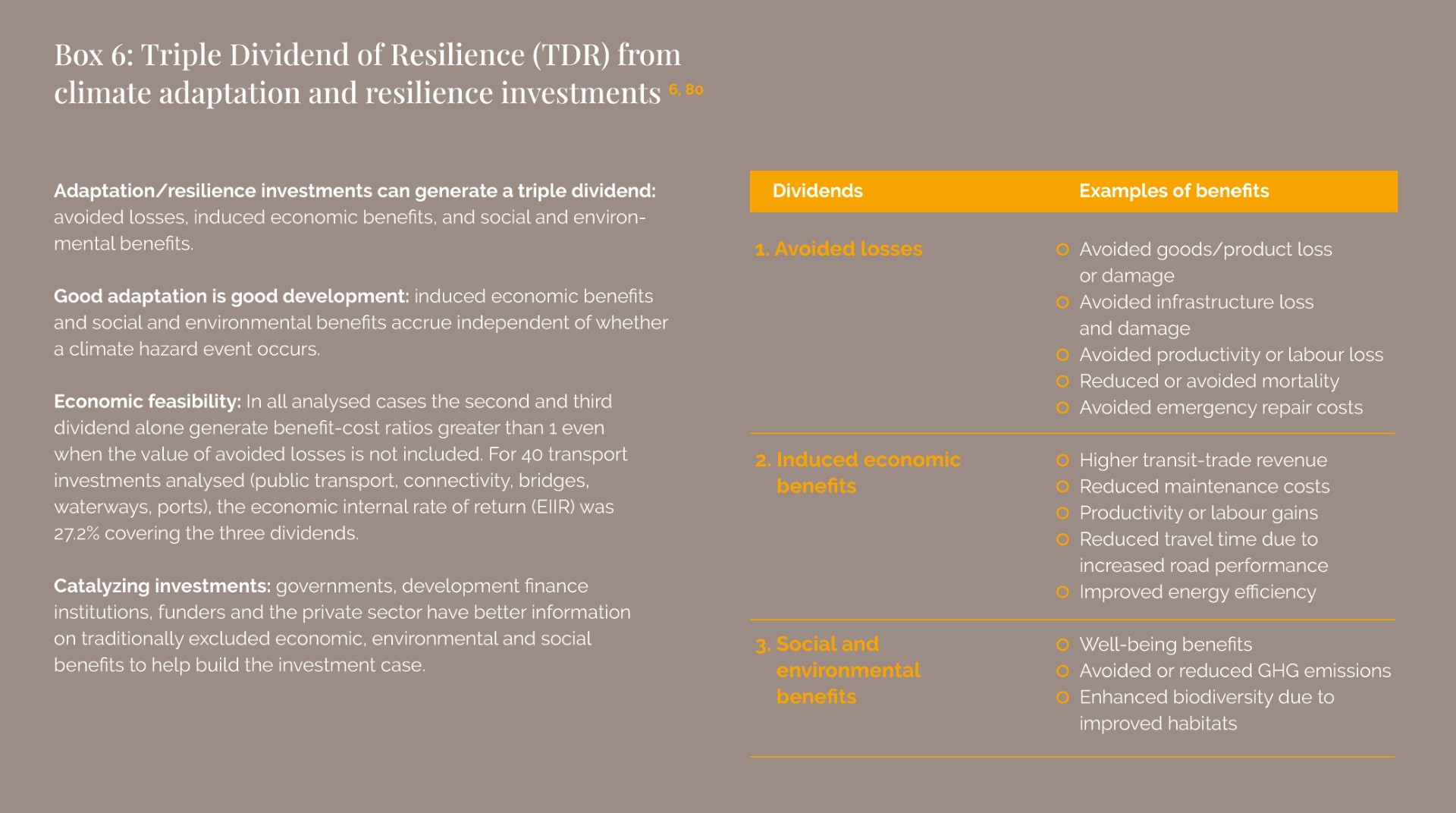
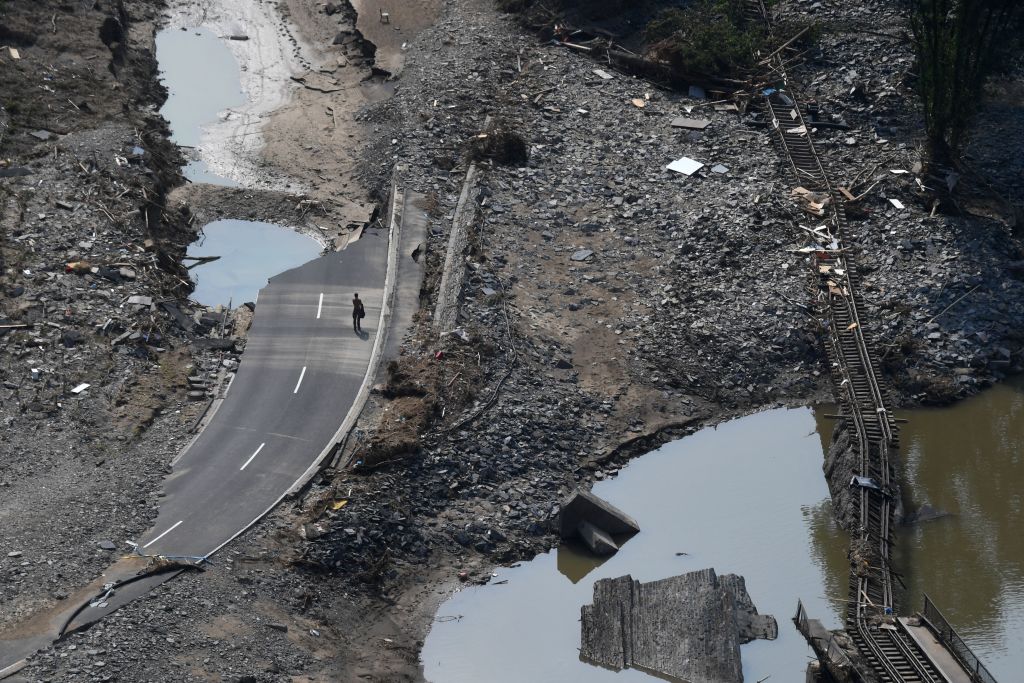
CDRI’s Disaster Resilient Infrastructure Hub made the case that resilient infrastructure is a core economic and development strategy. Their Global Infrastructure Resilience 2025 report showed that for every 1 dollar in direct infrastructure damage, there are another 7.4 dollars in wider economic losses. Early investment pays off: disaster-resilient infrastructure could cut economic losses by 50%. This applies directly to roads, ports, rail lines, bridges and logistics hubs. ICSI launched a new Climate Resilient Infrastructure Report with a rural roads case study by ORIS and UNIDO in Côte d’Ivoire that reflects the Life-Links concept.
Opportunity: There is growing alignment between economic development and infrastructure resilience, supported by the Action Agenda. This helps make the case for climate-compatible upgrades to transport links, logistics hubs and corridors as part of national development priorities and corporate supply chain risk management. The Life-Links applications to Africa supply chains with Kuehne Climate Center will give concrete examples.
6. Development banks invest in adaptation, resilience and nature: introduce supply chain thinking and bring in insurers
A joint statement from 17 multilateral development banks committed to scale up climate finance, with a strong focus on adaptation, resilience and nature-positive investments that could create 150 million jobs. In 2024, MDBs provided USD 66 billion in climate finance, including USD 22 billion for adaptation, and they already invest in ports, corridors and other transport infrastructure. Earlier this year, foundations launched a USD 50 million Adaptation and Resilience Fund. Insurance is part of this picture as climate change may destabilize financial markets. Record payouts and insurers withdrawing from high-risk regions make it harder to finance and maintain critical transport links. Collective insurance standards could help, because in practice insurability determines investability.
Opportunity: Their collective commitment makes it easier for governments and logistics actors to work with MDBs on building and strengthening critical transport links. The real opportunity is to frame development loan proposals in the context of supply chain resilience and give insurers, foundations and other investors a seat at the table early on.
7. Transport had its own pavilion: unite to shape the climate agenda and fill the transport gap
COP30 hosted a Transport Pavilion for the first time, co-organised by Brazil and the SLOCAT Partnership. SLOCAT updated its Global Status Report for sustainable transport, and set out five transport priorities: Global Transport Goal (11 countries set a goal for low-emissions transport!), stronger NDCs (NDC tracker), climate finance, adaptation and resilience, and UNFCCC platforms.
These priorities helped position transport as a climate, development and resilience issue, and not only a mitigation topic. A Life-Links, Asociación Sustentar and Kuehne Climate Center’s session delivered its own 10 takeaways to make transport links in supply chains more resilient and sustainable.
Opportunity: The transport community can now shape the climate agenda more effectively in a united way, and fill the transport gap in national, corporate and funder climate strategies. There is no better moment to start the UN Decade for Sustainable Transport 2026-2035 and taking SLOCAT's ideas on board!
8. Cities showed strong leadership on adaptation: connect with transport systems and supply chains
COP30’s urban discussions came through two pavilions: the official Cities & Regions Hub and the Resilient Cities Pavilion hosted by IBAM. Both were almost entirely about adaptation. They covered heat, flooding and recovery, community vulnerability, nature-based solutions, ecological infrastructure, cooling, climate-resilient urban design and local financing. But aside from decarbonizing urban mobility, there was little coverage of how climate hazards disrupt transport systems and supply chains going in and out of cities.
Opportunity: With cities putting adaptation at the centre of development, there is a chance to bring transport and logistics into this conversation. Connecting urban resilience planning with supply chain needs can strengthen both communities and the systems that keep goods moving.
9. Brazil’s strong climate risk data: build resilient transport links in supply chains with trade partners
As COP30 host, Brazil’s AdaptaBrasil platform includes climate risk assessments for federal roads, rail lines and ports. These studies show where extreme heat, rainfall and flooding are likely to disrupt critical links in the coming decades. At COP30, Brazil’s transport association CNT also presented results from its climate-resilience survey: 70.6% of Brazilian transport companies reported financial losses in the past five years due to extreme climate events, including delays, route changes and asset damage. Few countries have this combination of government-level infrastructure data and company-level operational data.
Opportunity: This gives Brazil, companies and international partners a solid basis to work together on strengthening critical road, rail and port links, especially those serving major export and import supply chains such as soy and coffee through the Port of Santos.
10. The NAP Technical Guidelines make room for logistics: don’t stop at national borders
The updated UNFCCC NAP Technical Guidelines for National Adaptation Plans emphasize connected systems, transport networks, resilient infrastructure, food security, food distribution, and climate-proof livelihoods. All of this fits well with logistics and supply chain resilience and mirrors much of the Life-Links thinking.
But supply chains are not mentioned explicitly. Like most NAP processes, they focus on adaptation within national borders. That leaves a gap, because most countries rely on global supply chains for food, medicines, inputs and exports.
Opportunity: Countries updating their NAPs can choose to bring logistics systems and critical transport links into their adaptation priorities, especially where disruptions already affect livelihoods, production or supply chains. It can open doors for strategic and practical collaboration between countries that connects climate action, economic cooperation and resilience.
What does all of this mean?
COP30 confirmed that adaptation is now taken more seriously. It also showed growing interest in infrastructure resilience, finance and the role of communities. But supply chains and logistics still appear only indirectly. They show up in transport, infrastructure and city discussions, but rarely in an integrated way that reflects how these links work across communities, sectors and countries.
For me, the core insight is straightforward: climate adaptation will not work if the logistics systems and transport links that supply chains rely on are left out. These systems feel climate impacts early and often. COP30 opened space for this discussion, but the specifics still need to be built.
The good news is that there is real interest from governments, companies, development partners, financiers and insurers, and civil-society actors to understand how strengthening logistics systems and critical transport links can support climate action, trade and local sustainable development.
The next step is turning this interest into concrete work that strengthens the links supply chains depend on. The Life-Links way of course!