Part A. Why Resilience
A-1. Supply Chains, Logistics, and the Climate Challenge
Supply chains are our lifelines. They have always underpinned societies, from ancient trade routes to today’s global networks. Now they represent an even greater share of how the world works, with trade equaling 57% of the world’s GDP.1 When the weakest link in a supply chain breaks, everyone suffers, especially the most vulnerable. Wildfires, cyberattacks, floods, power blackouts, storms, strikes, tariffs – every week seems to add a new disruption to the list. Combined with growing geopolitical instability and the possibility of future pandemics, we face a perfect storm.
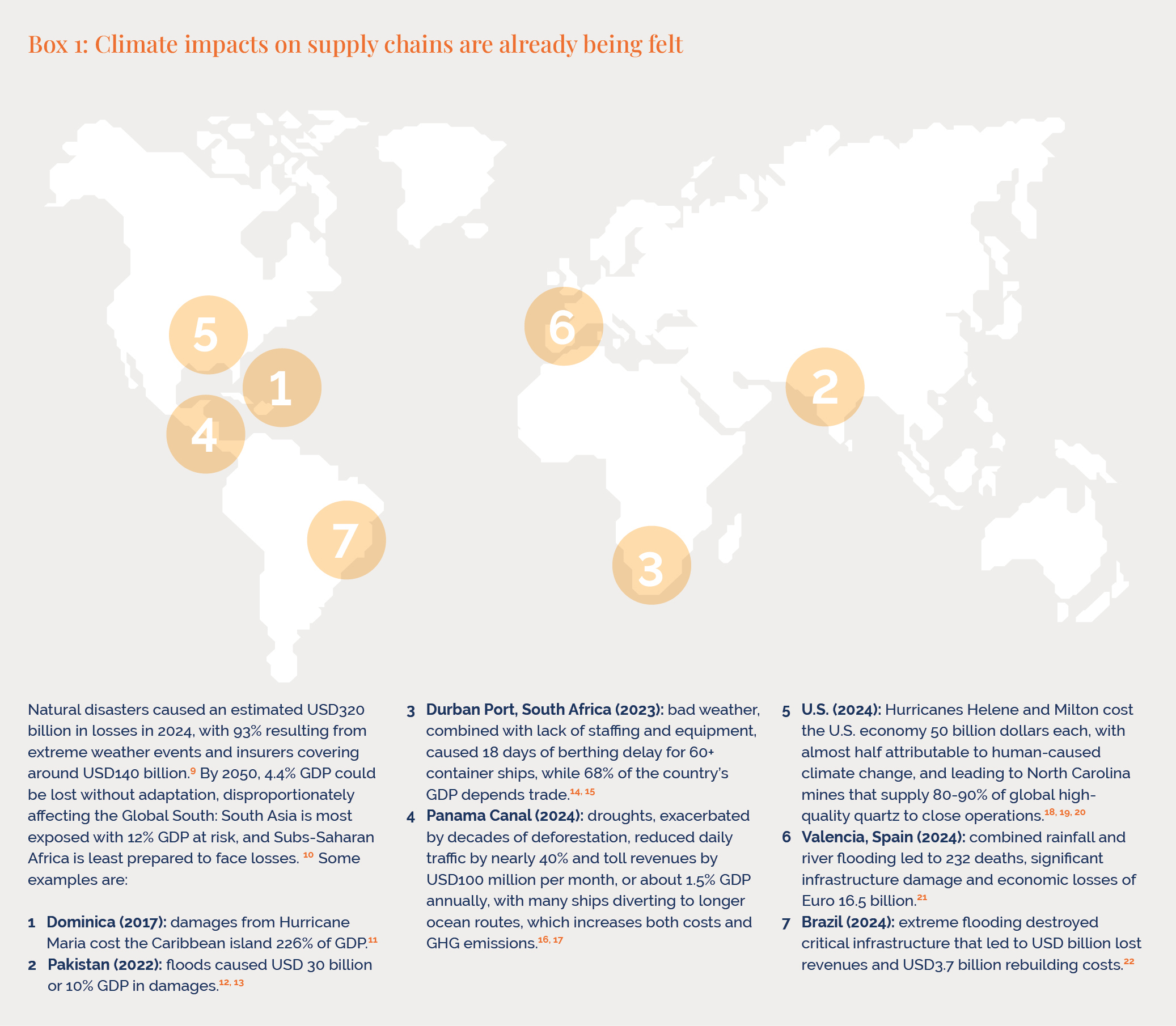
Climate change poses a growing threat to supply chains, through both acute hazards such as storms, floods, and heatwaves, as well as slow-onset chronic hazards like sea level rise and shifting weather patterns. Weather anom- alies can disrupt supply chains, leading to inflationary pressures.2 Moreover, climate change may exacerbate disruptions caused by other factors – geopolitical conflicts, pandemics, earthquakes, and accidents – and vice versa. The social, economic, and environmental impacts are vast and worsening as climate change intensifies.
Logistics infrastructure and operations are particularly vulnerable to climate hazards, and no supply chain can function without it. For example, 27% of global road and rail infrastructure is exposed to at least one natural hazard, and 86% of ports are exposed to more than three.3 4 5 Every USD 1 investment in adaptation measures can yield >USD 10 in benefits.6 Measures to climate-proof infrastructure add roughly 3% to total infrastructure investment costs in low- and middle-income countries, yet deliver a cost-benefit ratio greater than 1 in 96% of cases.7
Research suggests that in freight transport systems around two-thirds of resilience-enhancing measures can also cut greenhouse gas emissions.8
However, responses to supply chain disruptions by governments and companies tend to be reactive, localized, and isolated, driven by short-term interests. Avoiding and managing risks help reduce disruptions and its impacts, but they don’t solve the core underlying issues. To truly improve resilience, we must structurally strengthen supply chains for the long-term benefit of all: communities, companies, countries, and consumers.
 References: